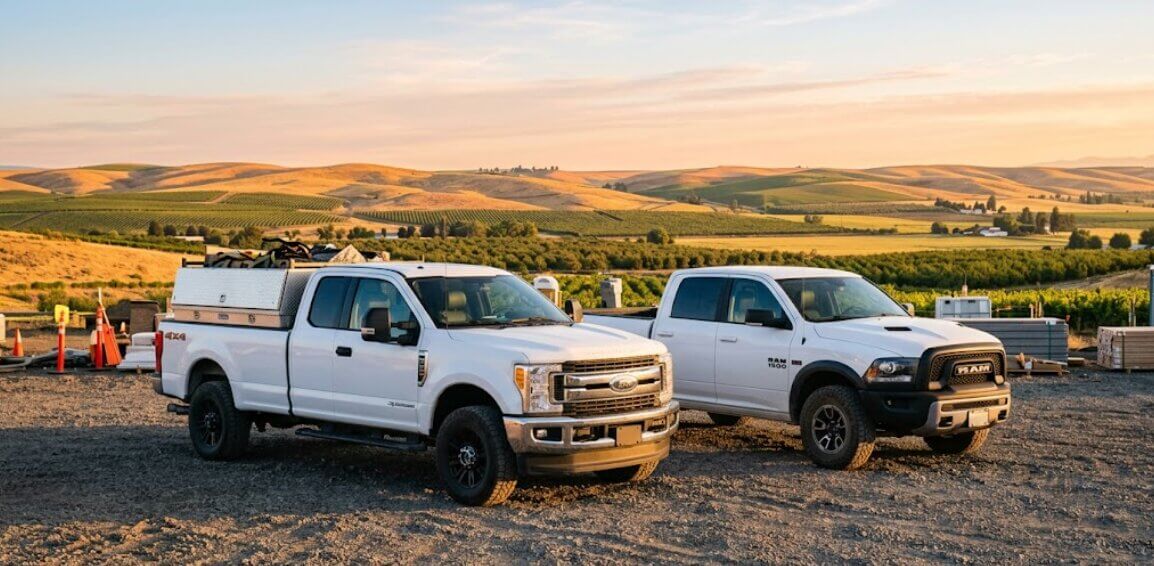

Selecting the right vehicle for a demanding job in the Pacific Northwest isn’t just about the brand. It’s about choosing a tool that can handle the season.
Whether you’re hauling hay in the Yakima Valley or moving heavy machinery to a job site in the Tri-Cities, your truck plays a critical role. It is the backbone of your operation.
The challenge lies in balancing massive towing capacities with the daily drivability needed for Washington’s diverse terrain and unpredictable weather. A truck that fails on a snowy mountain pass or gets stuck in a muddy field isn’t just an inconvenience—it’s a loss of revenue. In this guide, we will break down the top work trucks tailored for local agricultural and construction needs, comparing payload, durability, and the specific features that help Washington professionals stay productive year-round.
Why This Topic Matters for Washington Drivers
In Washington, a truck is rarely just a commuter vehicle. For our local farmers and contractors, “work trucks” represent a significant capital investment that must perform under pressure. Our geography creates a unique set of demands that off-the-lot base models don’t always meet without careful selection. From the steep grades of the Cascades to the heat of the eastern high desert, the mechanical strain on an engine and transmission is significantly higher here than in flatter regions of the country.
Furthermore, Washington’s weather patterns require specific configurations. We deal with heavy rainfall on the coast and frozen, rutted roads in the interior. For a contractor, this means needing a four-wheel-drive system that is sophisticated enough to handle ice while carrying a bed full of lumber. For a farmer, it means needing a cooling system that can handle idling in 100-degree heat during harvest season. Choosing the right setup ensures that your vehicle doesn’t just do the job today, but continues to do it five years and 150,000 miles down the road.
Best Options, Key Comparisons, or Core Recommendations
Heavy-Duty Diesel Powerhouses
When the job involves towing livestock trailers or heavy excavation equipment, the 2500 and 3500 series trucks are the gold standard. Models like the Ram 2500 with the Cummins Turbo Diesel or the Chevrolet Silverado 2500 HD with the Duramax engine offer the torque necessary to move mountains. These trucks are designed with reinforced frames and advanced exhaust braking systems, which are essential for safely descending steep Washington grades with a full load.
The Versatile Half-Ton Workhorse
For many independent contractors and smaller farm operations, a full-size half-ton truck like the Ford F-150 or Chevrolet Silverado 1500 provides the perfect balance. Modern half-tons have seen massive leaps in towing technology, often capable of pulling over 13,000 pounds when properly equipped. These are ideal for those who need a mobile office that can still navigate tight city streets or residential job sites without the massive footprint of a heavy-duty rig. When narrowing down your search, it is helpful to consult expert heavy-duty truck rankings to see how specific configurations for the current model year stack up in terms of long-term reliability and owner satisfaction.
Read More: The Future of EVs: ADAS Service Revolution in a Nutshell
Mid-Size Trucks for Specialized Utility
Don’t overlook mid-size options like the Toyota Tacoma or Nissan Frontier if your work involves navigating narrow orchard rows or forest service roads. While they lack the raw towing power of their larger siblings, their maneuverability and lower overhead costs make them excellent “scout” trucks for farm managers or inspectors who need to get into places where a dual-rear-wheel truck simply won’t fit.
How to Choose the Right Setup or Features
Prioritizing Payload vs. Towing Capacity
One of the most frequent mistakes is confusing towing capacity with payload. Contractors often max out their payload by installing heavy toolboxes, racks, and a bed full of materials, forgetting that the tongue weight of a trailer also counts toward that limit. If you plan on keeping a permanent service body on the back, you should almost always look at a 3500-series (one-ton) truck to ensure the suspension can handle the constant vertical pressure without sagging.
Selecting the Right Axle Ratio
When ordering or selecting work trucks from a dealership, pay close attention to the rear axle ratio. A higher numerical ratio, like 4.10, provides more pulling power. It helps get heavy loads moving and improves hill climbing. However, it may slightly reduce fuel economy on the highway.
A lower ratio, such as 3.21, is better for highway driving. It suits those who spend a lot of time on the I-82 or I-5 without a trailer. This setup keeps engine RPMs lower at cruising speeds.
Essential Weather and Terrain Add-ons
For Washington drivers, certain features should be considered non-negotiable. An electronic locking rear differential is a lifesaver when one wheel is on wet grass and the other is on mud. Additionally, integrated trailer brake controllers and extendable towing mirrors increase safety significantly. You can also review safety recommendations from the National Highway Traffic Safety Administration before making a final decision on which driver-assistance features are worth the investment for your fleet.
Common Mistakes or Buying Considerations
The biggest mistake many buyers make is “under-trucking” to save on the initial purchase price. Buying a half-ton truck for a job that truly requires a three-quarter-ton leads to accelerated wear on the brakes, transmission, and suspension. Within two years, the maintenance costs often exceed what the larger truck would have cost originally.
Read More: Why 2026 Car Prices Will Soar High Due to Tariffs
Another consideration is the choice between gas and diesel. Diesel engines offer strong torque and long life. However, modern heavy-duty gas engines are now highly capable. They also come with lower upfront costs and simpler emissions systems.
If your daily work involves short trips or frequent idling, a gas engine may be the better choice. Diesel engines perform best on long hauls, where they can reach optimal operating temperature.
Finally, consider the upfit potential. Make sure the truck’s frame and electrical system can support flatbeds, hoists, or plows your business needs.
Frequently Asked Questions
Q: Is four-wheel drive necessary for work trucks in Washington?
A: While it adds to the purchase price, 4WD is highly recommended for Washington professionals. Between the winter snow in the mountains and the muddy conditions on farms during the rainy season, the added traction is essential for ensuring you never have a “down day” due to weather.
Q: Should I choose a long bed or a short bed for a construction truck?
A: For contractors, an 8-foot long bed is usually preferred because it allows you to carry 4×8 sheets of plywood or drywall with the tailgate closed. However, if you do a lot of urban work, a standard 6.5-foot bed offers better maneuverability and still provides ample space for most tools.
Q: How does towing in the mountains affect my truck’s maintenance schedule?
A: Towing on steep grades is considered “severe service.” You should expect to change your transmission fluid, brake pads, and engine oil more frequently than the standard owner’s manual suggests to account for the increased heat and friction generated by Washington’s terrain.
Ready to find your next vehicle? Visit Speck Dealerships in Yakima or Tri-Cities today — or browse our inventory online.